[skip-to-content]
\( \newcommand{\lt}{<} \newcommand{\gt}{>} \newcommand{\amp}{&} \)

Sección6Funciones Reales

En esta sección de abordaran los principales conceptos de la funciones reales, incluyendo la funciones sobre los naturales, es decir, las sucesiones de números reales

Subsección6.1Introducción

Definición6.1

Se dice que \(f\) es una Función Real si y sólo si

  1. \(f \subseteq \mathbb{R}^2\) y
  2. \((\forall x,y,z \in \mathbb{R} )((x,y),(x,z)\in f \Rightarrow y=z)\)
Observación:

En el caso general se dice que \(f\) es una función de \(A\) en \(B\) si y sólo si \(f\) un subconjunto de \(A \times B\) y \((\forall x\in A)(\exists ! y\in B)((x,y)\in f )\)

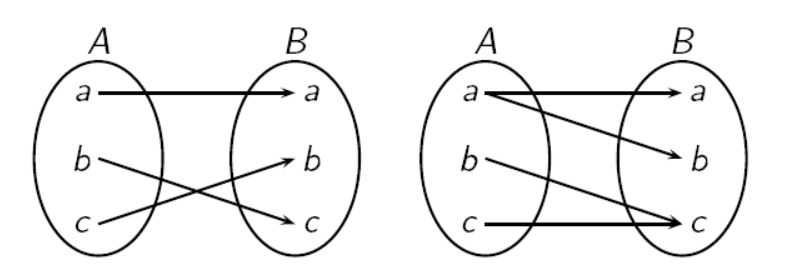
El primer gráfico “papy” representa una función y el segundo no:
La siguiente relación es una función

\begin{equation*} \mathcal{L}=\{(x,y)\in \mathbb{R}^2\ | \ 2x+3y=1 \}. \end{equation*}

La siguiente relación no es una función

\begin{equation*} \mathcal{P}=\{ (x,y)\in \mathbb{R}^2\ | \ y^2=4x+1 \} \end{equation*}
Definición6.4Dominio de una Función

Se define el Dominio de \(f\) igual al conjunto

\begin{equation*} Domf=\{x\in \mathbb{R}\ \ | \ \ (\exists ! y\in \mathbb{R} )((x, y)\in f) \}. \end{equation*}
Definición6.5Recorrido de una Función

Se define el Recorrido de la función \(f\) igual al conjunto

\begin{equation*} Rec(f)=\{y\in\mathbb{R}\ \ | \ \ (\exists x\in \mathbb{R})((x,y)\in f )\} \end{equation*}
Notación:

Sea \(f\) una función, luego podemos escribir la función usando el siguiente código

\begin{equation*} \begin{array}{rccl} f: \amp \text{Dominio de } f \amp \longrightarrow \amp \text{Conjunto de llegada } \\ \amp \text{ variable } \amp \longmapsto \amp \text{ imagen única asociada } \\ \end{array} \end{equation*}

Donde “Conjunto de llegada” es un conjunto que contiene el Recorrido o la Imagen.

También en la literatura emplea otros nombres para Dominio y estos son Conjunto de Partida, Conjunto de las Preimagen

Subsección6.2Ejemplos de Dominio

Determine el Dominio de la función

\begin{equation*} \begin{array}{cccc} \mathcal{L}: \amp A \subseteq \mathbb{R} \amp \longrightarrow \amp \mathbb{R} \\ \amp x \amp \longmapsto \amp \frac{1-2x}{3} \end{array} \end{equation*}
Solución1

El dominio es \(Dom \mathcal{L}=\mathbb{R}\)

Determine el Dominio de la función

\begin{equation*} \begin{array}{cccc} \mathcal{L}: \amp A \subseteq \mathbb{R} \amp \longrightarrow \amp [1,\infty[ \\ \amp x \amp \longmapsto \amp \frac{1-2x}{3} \end{array} \end{equation*}
Solución2

Ya que debemos resolver \(\frac{1-2x}{3} \geq 1 \text{,}\) que equivalente a \(x \leq -1\text{,}\) de este modo tenemos que el dominio es \(Dom \mathcal{L}=]-\infty,-1]\)

Determinar el Dominio de la función

\begin{equation*} \begin{array}{cccc} f: \amp A \subseteq \mathbb{R}-\{4\} \amp \longrightarrow \amp ]-\infty, 2]\\ \amp x \amp \longmapsto \amp \dfrac{2x+5}{x-4} \end{array} \end{equation*}
Solución3

Para determinar el dominio de \(f\text{,}\) debemos resolver \(\frac{2x+5}{x-4} \leq 2 \text{,}\)

\begin{equation*} \begin{array}{rcl} \frac{2x+5}{x-4}-2 \amp \leq \amp 0 \\ \frac{13}{x-4} \amp \leq \amp 0 \\ x-4 \amp \lt \amp 0 \end{array} \end{equation*}

de este modo tenemos que el dominio es \(Dom f=]-\infty,4[\)

Subsección6.3Gráfica de Funciones

La gráfica de una función \(f:A\longrightarrow B\) se define como el conjunto de pares ordenados siguiente:

\begin{equation*} Graf(f)=\{(x,f(x))\in A\times B\mid y=f(x),x\in A\}\subset\mathbb{R}^2 \end{equation*}

La representación gráfica de \(f\) se llama curva y se consigue marcando los puntos del conjunto en el plano.

Graficar la función \(f(x)=2x+5\text{.}\)

Para graficar podemos hacer una tabla en donde representemos a la variable dependiente asignándole valores a la variable independiente y así podemos representar algunos puntos en el plano y conociendo la curva podremos trazarla, en este caso se trata de una recta luego nos bastan dos puntos, ellos son \((0,5),(1,7)\in f\text{.}\)

Solución1
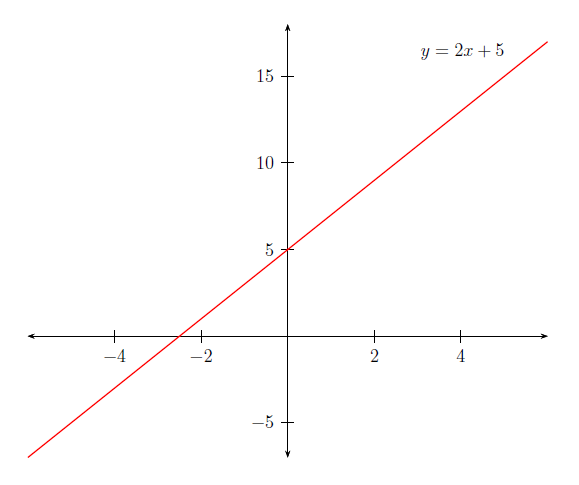
En general las Funciones Lineales Son funciones de la forma

\begin{equation*} \begin{array}[t]{cccl} f: \amp \mathbb{R} \amp \longrightarrow \amp \mathbb{R}\\ \amp x \amp \longmapsto \amp mx+b \end{array} \text{ con }m,b\in\mathbb{R}\text{.} \end{equation*}

Si \(y=f(x)\) entonces tenemos la ecuación \(y=mx+b\) y su gráfica corresponde a una recta de pendiente \(m.\) La inclinación o pendiente de la recta depende del valor de \(m.\)

Funciones Cuadráticas Son funciones de la forma

\begin{equation*} \begin{array}{cccl} f: \amp \mathbb{R} \amp \longrightarrow \amp \mathbb{R}\\ \amp x \amp \longmapsto \amp ax^2+bx+c \end{array} \text{ con }a,b,c\in\mathbb{R} \text{ y } a\not =0\text{.} \end{equation*}

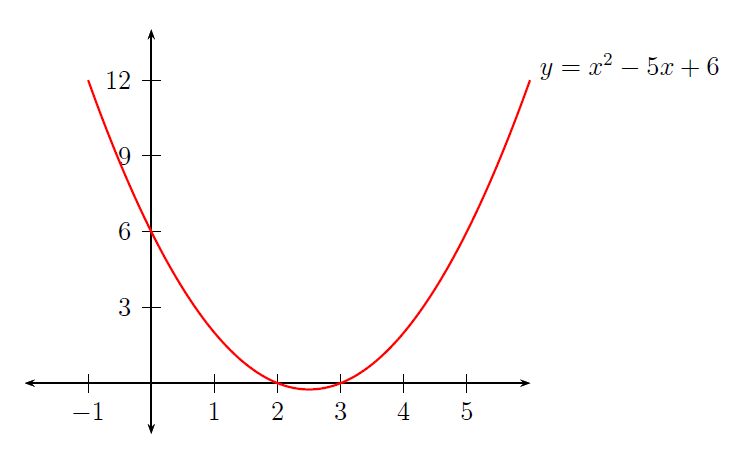
Si \(y=f(x)\) entonces \(y=ax^2+bx+c\text{,}\) luego la gráfica de la función corresponde a una parábola.

Un ejemplo de parábola esta dada por
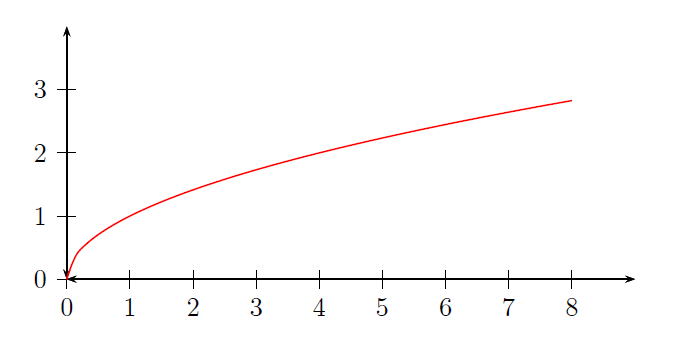
Función Raíz Cuadrada: Esta función se define como:

\begin{equation*} \begin{array}[t]{cccll} f: \amp \mathbb{R}_0^+ \amp \longrightarrow \amp \mathbb{R}_0^+ \\ \amp x \amp \longmapsto \amp \sqrt{x} \end{array} \end{equation*}

La gráfica de la función es la siguiente:
Función Valor Absoluto: Esta función se define como:

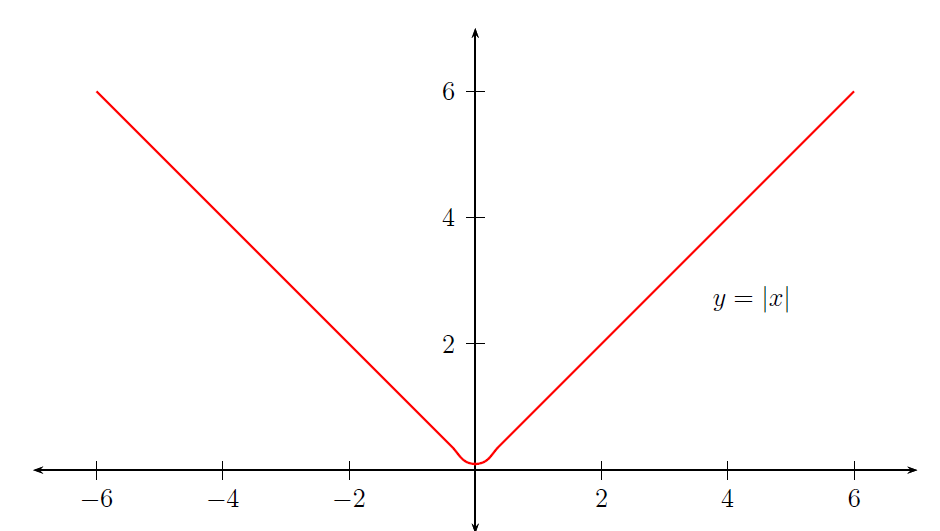
\begin{equation*} \begin{array}{cccl} f: \amp \mathbb{R} \amp \longrightarrow \amp \mathbb{R}\\ \amp x \amp \longmapsto \amp |x| \end{array} \end{equation*}

La gráfica de la función es la siguiente:
Otras notaciones para las funciones En general tenemos el uso de subíndice:

\begin{equation*} \begin{array}{ccccccc} f: \amp A \subseteq \mathbb{R} \amp \longrightarrow \amp B\subset \mathbb{R} \amp \qquad \amp \{f_i\}_{i\in A}\\ \amp i \amp \longmapsto \amp f(i)= f_i \end{array} \end{equation*}

Dos forma de escribir esta función son

\begin{equation*} \begin{array}{ccccccc} a: \amp \mathbb{N}_0 \amp \longrightarrow \amp \mathbb{R}; \amp \qquad \amp \left\{\frac{n(n+1)}{2}\right\}_{n\in \mathbb{N}_0} \\ \amp n \amp \longmapsto \amp a_n =\frac{n(n+1)}{2} \end{array} \end{equation*}

Podemos calcular \(a(0)= a_0= 0\text{,}\) \(a_3=a(3)= 6\)

Dada la función \(f\) definida por \(\{m^2+1\}_{m\in \mathbb{N}} \text{,}\)

Determinar los valores de \(f_1\text{,}\) \(f(3)\)

Solución2

La sucesión esta definida por

\begin{equation*} f(n)= n^2+1, \text{ con } n\in \mathbb{N} \end{equation*}

luego tenemos que \(f_1= 1^1+1=2\text{,}\) \(f(3)=3^2+1= 10\)

Subsección6.4Funciones definidas por recurrencia

Definición6.12Factorial
\begin{equation*} \begin{array}{cccc} !: \amp \mathbb{N}_0 \amp \longrightarrow \amp \mathbb{N} \\ \amp n \amp \longmapsto \amp n! \end{array} \end{equation*}

donde \(0!=1, \ (n+1)!= (n+1)(n!)\)

Algunos valores son

\begin{equation*} \begin{array}{rcl} 1! \amp = \amp 1 \\ 2! \amp = \amp 2 \\ 3! \amp = \amp 6\\ 4! \amp = \amp 24\\ 5! \amp = \amp 120 \end{array} \end{equation*}
Definición6.13Sumatoria

Dada la función \(\{a_i\}_{i\in \mathbb{N}_0}\)

\begin{equation*} \begin{array}{cccc} \sum : \amp \mathbb{N}_0 \amp \longrightarrow \amp \mathbb{R}\\ \amp n \amp \longmapsto \amp \sum_{i=0}^{n} a_i \end{array} \end{equation*}

donde \(\sum_{i=0}^0 a_i=a_0\) y \(\sum_{i=0}^{n+1} a_i= a_{n+1}+ \overset{n}{\underset{i=0}{\sum}} a_i\)

Además \(0 \lt n\leq m\)

\begin{equation*} \sum_{i=n}^{m} a_i= \sum_{i=0}^{m} a_i - \sum_{i=0}^{n-1} a_i \end{equation*}

Dada la función \(a_i=i^2+1 \) con \(i\in \mathbb{N}\text{,}\) calcular \(\sum_{i=2}^5 a_i\)

Solución1

El valor corresponde a

\begin{equation*} \overset{5}{\underset{i=2}{\sum}} a_i= a_2+a_3+a_4+a_5= 5+10+17+26= 58 \end{equation*}

Calcular \(\sum_{i=2}^5 i(n+i)\)

Solución2

El valor corresponde

\begin{equation*} \sum_{i=2}^{5} i(n+i)= 2(n+2) + 3(n+3) + 4(n+4)+ 5(n+5)= 14n+54 \end{equation*}

Calcular

\begin{equation*} \sum_{n=2}^5 i(n+i) \end{equation*}
Solución3
\begin{equation*} \sum_{n=2}^{5} i(n+i)= i(2+i) + i(3+i) + i(4+i)+ i(5+i)= 14i+4i^2 \end{equation*}
Definición6.17Igualdad de Funciones

Dadas dos funciones \(f:A\longrightarrow B\) y \(g:C\longrightarrow D\) se dice que \(f=g\) si y sólo si se cumple que:

\begin{equation*} (A=C)\wedge(B=D) \end{equation*}
\begin{equation*} (\forall x\in A)(f(x)=g(x)) \end{equation*}

o bien, dos funciones son iguales si tienen el mismo dominio y conjunto de llegada \(B\text{,}\) y para cada elemento del dominio idénticas imágenes.

Sean

\begin{equation*} \begin{array}[t]{lrl} f: \amp \mathbb{R}\longrightarrow \amp \mathbb{R}\\ \amp x \longmapsto \amp x+1\\ \end{array}\quad \text{ y }\quad \begin{array}[t]{lrl} g: \amp \mathbb{R}-\{0\}\longrightarrow \amp \mathbb{R}\\ \amp x \longmapsto \amp \frac{x(x + 1)}{x} \\ \end{array} \end{equation*}
Solución4

En este caso tenemos que \(f\neq g\) ya que \(Domf\neq Dom g.\)

Subsección6.5Algebra de Funciones

Definición6.19

Sean \(f\) y \(g\) funciones y \(D=Dom(f)\cap Dom(g)\not = \phi \) entonces se pueden definir una nuevas funciones.

1.- La suma de \(f\) y \(g\) se define por

\begin{equation*} \begin{array}{cccc} f + g: \amp D \amp \longrightarrow \amp \mathbb{R}\\ \amp x \amp \longmapsto \amp f(x)+ g(x) \end{array} \end{equation*}

2.- La diferencia de \(f\) y \(g\) se define por

\begin{equation*} \begin{array}{cccc} f - g: \amp D \amp \longrightarrow \amp \mathbb{R}\\ \amp x \amp \longmapsto \amp f(x)- g(x) \end{array} \end{equation*}

3.- El producto de \(f\) y \(g\) se define por

\begin{equation*} \begin{array}{cccc} f\cdot g: \amp D \amp \longrightarrow \amp \mathbb{R}\\ \amp x \amp \longmapsto \amp f(x)\cdot g(x) \end{array} \end{equation*}

4.- El producto por una escalar, caso especial se define como:

\begin{equation*} \begin{array}{cccc} \alpha f: \amp Dom (f) \amp \longrightarrow \amp \mathbb{R} \\ \amp x \amp \longmapsto \amp (\alpha f)(x)=\alpha f(x) \\ \end{array} \end{equation*}

5.- Si \(D'=\{x\in D\mid g(x)\not = 0\} \neq \phi\) entonces cuociente de \(f\) con \(g\) se define por

\begin{equation*} \begin{array}{cccc} \dfrac{f}{g}: \amp D' \amp \longrightarrow \amp \mathbb{R}\\ \amp x \amp \longmapsto \amp \frac{f(x)}{g(x)} \end{array} \end{equation*}

6.- Sean \(A,B\) subconjuntos de números reales y sean \(f:A\longrightarrow \mathbb{R}\) y \(g:B\longrightarrow \mathbb{R}\) dos funciones tales que

\begin{equation*} C=\{x\in A \mid f(x)\in B\} \neq \phi. \end{equation*}

Entonces se define la compuesta de \(f\) y \(g\) dada por:

\begin{equation*} \begin{array}{cccl} (g\circ f): \amp C \amp \longrightarrow \amp \mathbb{R}\\ \amp x \amp \longmapsto \amp g(f(x)) \end{array} \end{equation*}

Claramente tenemos que \(C=Dom(g\circ f)\)

Observación:

Un caso particular donde ésta definición se cumple, es cuando tenemos que \(Rec(f)\subseteq Domg=B\text{,}\) entonces \(Dom(g\circ f)=Dom(f)=C \)

Sean

\begin{equation*} \begin{array}{lccl} f: \amp [-2,2]\longrightarrow \amp \mathbb{R}\\ \amp x \longmapsto \amp \sqrt{4-x^2} \end{array}\ \ \begin{array}{lccl} g: \amp \mathbb{R} \amp \longrightarrow \amp \mathbb{R}\\ \amp x \amp \longmapsto \amp 3x+1\\ \end{array} \end{equation*}

Encontrar la suma, la resta, el producto y el cuociente de \(f\) con \(g\text{.}\)

Solución1

El dominio de \(f\) es \(Dom(f)=[-2,2]\) y el de \(g\) es \(Dom(g)=\mathbb{R}\text{.}\)

Luego

\begin{equation*} Dom(f)\cap Dom(g)=[-2,2]\neq \phi \end{equation*}

La suma de \(f\) y \(g\)

\begin{equation*} \begin{array}{lrl} (f+g): \amp [-2,2]\longrightarrow \amp \mathbb{R}\\ \amp x \longmapsto \amp \sqrt{4-x^2}+(3x+1)\\ \end{array} \end{equation*}

La diferencia

\begin{equation*} \begin{array}{lrl} (f-g): \amp [-2,2]\longrightarrow \amp \mathbb{R}\\ \amp x \longmapsto \amp \sqrt{4-x^2}-(3x+1)\\ \end{array} \end{equation*}

El producto

\begin{equation*} \begin{array}{lrl} (fg): \amp [-2,2]\longrightarrow \amp \mathbb{R}\\ \amp x \longmapsto \amp \sqrt{4-x^2} \cdot(3x+1) \end{array} \end{equation*}

El cuociente

\begin{equation*} \begin{array}{lrl} \left(\dfrac{f}{g}\right) : \amp [-2,2]-\{\frac{-1}{3}\}\longrightarrow \amp \mathbb{R}\\ \amp x \longmapsto \amp \frac{\sqrt{4-x^2}}{3x+1} \end{array} \end{equation*}

Sea

\begin{equation*} \begin{array}{rccl} f: \amp \mathbb{R}-\{0\} \amp \longrightarrow \amp \mathbb{R}-\{0\}\\ \amp x \amp \longmapsto \frac{1}{x} \end{array} \end{equation*}

Encontrar \(f\circ f\text{,}\) \(f\circ f\circ f\)

Solución2

Sabemos que \(Recf \subseteq Domf \text{,}\) luego \(Dom (f\circ f) = Dom f \text{,}\) calculemos ahora la imagen.

\begin{equation*} (f\circ f)(x) = f(f(x)) = f(\frac{1}{x}) = \frac{1}{\frac{1}{x}} = x \end{equation*}

luego tenemos

\begin{equation*} \begin{array}{rccl} f\circ f: \amp \mathbb{R}-\{0\} \amp \longrightarrow \amp \mathbb{R}-\{0\}\\ \amp x \amp \longmapsto \amp x \end{array} \end{equation*}

La otra compuesta la obtenemos

\begin{equation*} (f\circ f\circ f)(x) = f((f\circ f)(x)) = f(x) = \frac{1}{x} \end{equation*}

así tenemos

\begin{equation*} \begin{array}{rccl} f\circ f \circ f : \amp \mathbb{R}-\{0\} \amp \longrightarrow \amp \mathbb{R}-\{0\}\\ \amp x \amp \longmapsto \amp \frac{1}{x} \end{array} \end{equation*}

Subsección6.6Funciones Biyectivas

Definición6.22

Sea \(f:A \longrightarrow B\) una función, diremos que \(f\) es Biyectiva si y sólo si existe una función \(g:B \longrightarrow A\) tal que

  1. \((\forall b\in B)((f\circ g)(b)=b) \) y
  2. \((\forall a\in A )((g\circ f)(a)=a ).\)

La función \(g\) se llama función inversa de \(f\) y se denota por \(f^{-1}\text{.}\)

Observación: Para la existencia de tal función es necesario que todo elemento de \(B\) tenga preimagen, es decir \(B=Recf\text{.}\) Además no pueden existir dos elemento que tenga la misma imagen.

Definición6.23

Una función \(f:A \longrightarrow B\)

  1. se dice que \(f\) es inyectiva si y sólo si
    \begin{equation*} (\forall a, b\in A)(f(a)=f(b)\Longrightarrow a=b) \end{equation*}
    Es decir, \(f\) es inyectiva si y sólo si todo \(y\in Rec(f)\) tiene una y sólo una preimagen en el \(Dom(f)\text{.}\)
  2. se dice que \(f\) es epiyectiva o sobreyectiva si y sólo si \(Rec(f)=B\text{.}\) Es decir, todo elemento del conjunto de llegada tiene preimagen

Demostrar la inyectividad de la siguiente función

\begin{equation*} \begin{array}{lrl} f: \amp \mathbb{R}-\{2\} \longrightarrow \amp \mathbb{R}-\{3\} \\ \amp x \longmapsto \amp \frac{3x+2}{x-2} \end{array} \end{equation*}
Solución1

Sean \(x,y\in \mathbb{R}-\{2\}\) tales que

\begin{equation*} \begin{array}{llrcl} f(x)=f(y) \amp \Longrightarrow \amp \dfrac{3x+2}{x-2} \amp = \amp \dfrac{3y+2}{y-2}\\ \amp \Longrightarrow \amp (3x+2)(y-2) \amp = \amp (3y+2)(x-2) \\ \amp \Longrightarrow \amp 3xy+2y-6x-4 \amp = \amp 3xy+2x-6y-4\\ \amp \Longrightarrow \amp 2y-6x \amp = \amp 2x-6y \\ \amp \Longrightarrow \amp 8y \amp = \amp 8x \\ \amp \Longrightarrow \amp y \amp = \amp x \end{array} \end{equation*}

Luego \(f\) es inyectiva.

Determinemos la epiyectiva de la siguiente función

\begin{equation*} \begin{array}{lrl} f: \amp \mathbb{R}-\{2\} \longrightarrow \amp \mathbb{R}-\{3\} \\ \amp x \longmapsto \amp \frac{3x+2}{x-2} \end{array} \end{equation*}
Solución2

Para ello sea \(x\in Dom(f)=\mathbb{R}-\{2\}\) y \(y \in Rec(f)\)

\begin{equation*} \begin{array}{rcl} \dfrac{3x+2}{x-2}=y \amp \Leftrightarrow \amp 3x+2=yx-2y \\ \amp \Leftrightarrow \amp 3x-yx=-2y-2 \\ \amp \Leftrightarrow \amp x(3-y)=-2y-2; y \neq 3 \\ \amp \Leftrightarrow \amp x=\dfrac{2y+2}{y-3} \end{array} \end{equation*}

Además \(x\neq 2\text{,}\)

\begin{equation*} \dfrac{2y+2}{y-3}=2 \Leftrightarrow 2=-6 \end{equation*}

Así tenemos que \(Rec(f)= \mathbb{R}-\{3\}\) y la función inversa es

\begin{equation*} \begin{array}{lrl} f^{-1}: \amp \mathbb{R}-\{3\} \longrightarrow \amp \mathbb{R}-\{2\} \\ \amp y \longmapsto \amp \frac{2y+2}{y-3} \end{array} \end{equation*}

Subsección6.7Ejercicios Funciones Reales

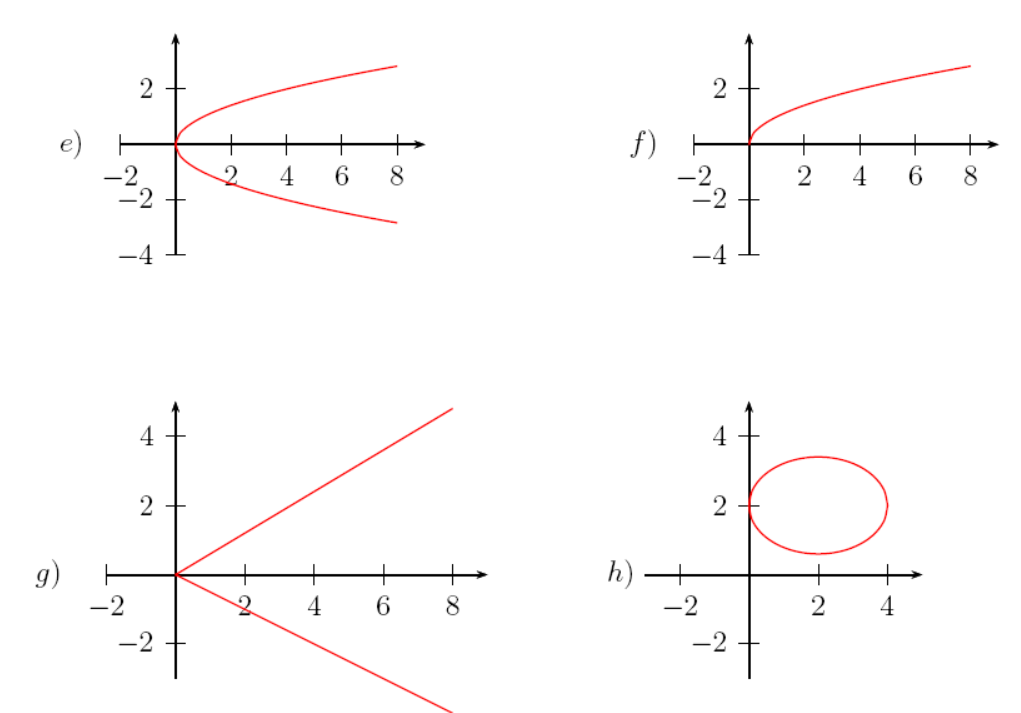
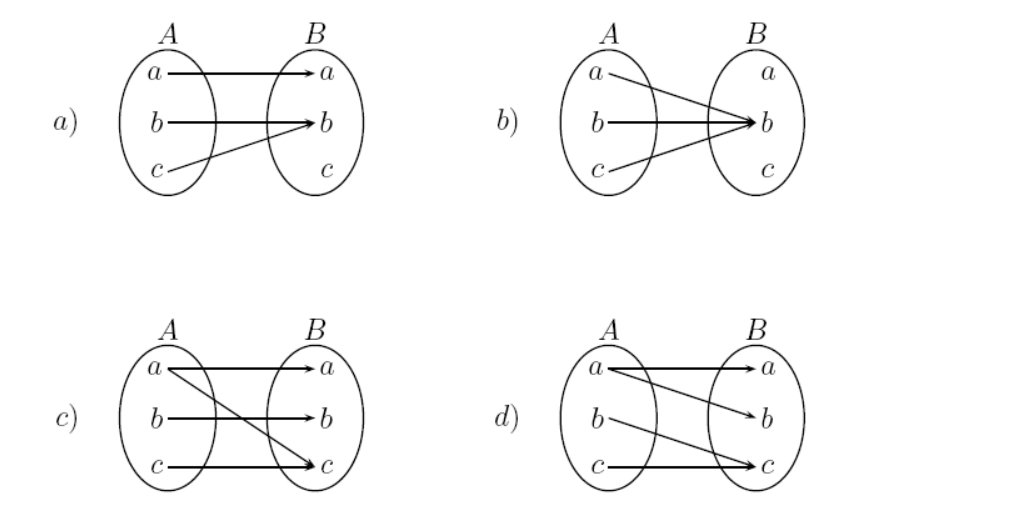
  1. Determinar en cada caso, cual gráfico corresponde a una función
  2. Dada la función

    \begin{equation*} % \begin{array}[c]{cccc}% f: \amp \mathbb{R} \amp \longrightarrow \amp \mathbb{R}\\ \amp x \amp \longmapsto \amp \frac{x+2}{|x|+1}% \end{array} \end{equation*}

    Evaluar la función en:

    Pista

    Note que

    \begin{equation*} f(\sqrt{2})= \frac{\sqrt{2}+ 2}{|\sqrt{2}|+1}= \frac{\sqrt{2}+ 2}{\sqrt{2}+1} =\frac{(\sqrt{2}+ 2)(\sqrt{2}-1)}{1}=\sqrt{2}. \end{equation*}
    1. \(f(4)\)
    2. \(f(f(1))\)
    3. \(f(\sqrt{2})\)
    4. \(f(\sqrt{2}-3)\)
    5. \(f(z+1)\)
    6. \(f(x-2)\)
  3. Dada la función

    \begin{equation*} \begin{array}[c]{cccc}% f: \amp \mathbb{R} \amp \longrightarrow \amp \mathbb{R}\\ \amp x \amp \longmapsto \amp \frac{|1-x|+4}{3} \end{array} \end{equation*}

    Determinar los siguientes valores:

    1. \(f(-2)\)
    2. \(f(\sqrt{2})\)
    3. \(f(f(-1))\)
    4. \(f(f(f(-1)))\)
  4. Dada la función

    \begin{equation*} % \begin{array}[c]{cccc}% f: \amp \mathbb{R} \amp \longrightarrow \amp \mathbb{R}\\ \amp x \amp \longmapsto \amp \frac{|2-x|+4}{3} \end{array} \end{equation*}

    Determinar los siguientes valores:

    1. \(f(-2)\)
    2. \(f(\sqrt{2})\)
    3. \(f(f(1))\)
    4. \(f(f(f(1)))\)
  5. Determinar \(A\subset\mathbb{R}\text{,}\) “mayor posible” de modo que \(f\) sea una función

    Pista

    Note que, para que \(f\) sea función, la expresión \(2x+3\) no puede ser negativa,

    \begin{equation*} 2x+3 \geq 0 \Leftrightarrow x \geq -\frac{3}{2},\hspace{1cm} A=Dom f= ........ \end{equation*}

    para que \(g\) sea función, la expresión \(|x|-1\) no puede ser cero.

    \begin{equation*} |x|-1 \neq 0 \Leftrightarrow |x| \neq 1,\hspace{1cm} A=Dom g= ........ \end{equation*}
    1. \begin{equation*} \begin{array}[c]{cccc} f: \amp A\subset\mathbb{R} \amp \rightarrow \amp \mathbb{R}\\ \amp x \amp \mapsto \amp \sqrt{2x+3} \end{array} \end{equation*}
    2. \begin{equation*} \begin{array}[c]{cccc} g: \amp A\subset\mathbb{R} \amp \longrightarrow \amp \mathbb{R}\\ \amp x \amp \longmapsto \amp \frac{x+2}{|x|-1} \end{array} \end{equation*}
    3. \begin{equation*} \begin{array}[c]{cccc} h: \amp A\subset\mathbb{R} \amp \rightarrow \amp \mathbb{R}\\ \amp x \amp \mapsto \amp \frac{x}{x^2-3}% \end{array} \end{equation*}
    4. \begin{equation*} \begin{array}[c]{cccc}% k: \amp A\subset\mathbb{R} \amp \longrightarrow \amp \mathbb{R}\\ \amp x \amp \longmapsto \amp \frac{1}{x^2+3x-4} \end{array} \end{equation*}
    5. \begin{equation*} \begin{array}[c]{cccc}% l: \amp A\subset\mathbb{R} \amp \rightarrow \amp \mathbb{R}\\ \amp x \amp \mapsto \amp \frac{\sqrt{x}}{x+3} \end{array} \end{equation*}
  6. Determinar \(A\subseteq\mathbb{R}\) lo “mayor posible”, de modo que \(f\) sea una función

    \begin{equation*} \begin{array}[c]{cccc} f: \amp A\subseteq\mathbb{R} \amp \rightarrow \amp \mathbb{R}\\ \amp x \amp \mapsto \amp \sqrt{\frac{1}{x}-3}% \end{array} \end{equation*}
  7. Determinar \(A\subseteq\mathbb{R}\) lo “mayor posible”, de modo que \(f\) sea una función

    \begin{equation*} % \begin{array}[c]{cccc}% f: \amp A\subseteq\mathbb{R} \amp \rightarrow \amp \mathbb{R}\\ \amp x \amp \mapsto \amp \sqrt{\frac{1}{x}-1}% \end{array} \end{equation*}
  8. Considere las siguientes funciones

    \begin{equation*} % \begin{array}[c]{cccc}% f: \amp \mathbb{R} \amp \longrightarrow \amp \mathbb{R}\\ \amp x \amp \leadsto \amp f(x)=4-x \end{array} \hspace{2cm} \begin{array} [c]{cccc}% g: \amp \mathbb{R} \amp \longrightarrow \amp \mathbb{R}\\ \amp x \amp \leadsto \amp g(x)=-x^{2}+1 \end{array} \end{equation*}

    Calcular los valores

    1. \(g(f(4))\)
    2. \(f(g(4))\)
    3. \(f(g(x))\)
    4. \(g(f(x))\)
    5. \(f(f(x))\)
    6. \(g(g(x))\)
  9. Dadas las funciones:

    \begin{equation*} \begin{array}{cccl} g: \amp \mathbb{R} \amp \longrightarrow \amp \mathbb{R}\\ \amp x \amp \longrightarrow \amp x+2 \end{array} \hspace{2cm} \begin{array}{cccl} f: \amp \mathbb{R} \amp \longrightarrow \amp \mathbb{R}\\ \amp x \amp \longrightarrow \amp x^2-3x \end{array} \end{equation*}

    Determinar el valor, en cada caso

    Pista

    Note que \(g(1)=1+2= 3\) y \(f(3)=9-9=0\text{,}\) luego tenemos

    \begin{equation*} f(g(1))=f(3)=0. \end{equation*}
    1. \(f(g(1))\)
    2. \(g(f(2)) \)
    3. \(f(g(x))\)
    4. \(g(f(x))\)
  10. Dadas las funciones:

    \begin{equation*} \begin{array}{cccl} g: \amp \mathbb{R} \amp \longrightarrow \amp \mathbb{R}\\ \amp x \amp \longrightarrow \amp x-2 \end{array} \hspace{2cm} \begin{array}{cccl} f: \amp \mathbb{R} \amp \longrightarrow \amp \mathbb{R}\\ \amp x \amp \longrightarrow \amp x^2+3x \end{array} \end{equation*}

    Determinar el valor, en cada caso

    1. \(f(g(1))\)
    2. \(g(f(2)) \)
    3. \(f(g(x))\)
    4. \(g(f(x))\)
  11. Dada las funciones en su dominio máximo

    \begin{equation*} f(x)=2x+1;\qquad g(x)=2-3x \end{equation*}

    entonces:

    Determine si la afirmación son verdaderas o falsas

    1. \(f(x-1)=2x\) .......................
    2. \(f(2x)=4x^{2}+1\) .......................
    3. \(f(g(x))=-3x+5\) .......................
    4. \(g(f(x-2)+2)=1-6x\text{......................}\)
  12. Sea \(g\) una función de \({\mathbb{R}}\) en \({\mathbb{R}}\) definida por:

    \begin{equation*} \begin{array}{cccl} g: \amp \mathbb{R} \amp \longrightarrow \amp \mathbb{R}\\ \amp x \amp \longrightarrow \amp g(x)=\left \{ \begin{array}{cc} 3x+7 \amp x \leq 1 \\ \sqrt{x}-1 \amp x > 1 \end{array} \right. \end{array} \end{equation*}

    Determinar el valor

    Pista

    Note que \(-1 \leq 1\text{,}\) luego \(g(-1)=3*(-1)+7= 4\)

    Para el otro caso \(4 \gt 1\text{,}\) por ello \(g(2)=\sqrt{4}-1=1\)

    1. \(g(-1)\)
    2. \(g(4)\)
    3. \(g(0)\)
    4. \(g(2)\)
    5. \(g(g(-3))\)
    6. \(g(g(9))\)
  13. Dada la función

    \begin{equation*} % \begin{array}[c]{cccc}% f: \amp \mathbb{R} \amp \longrightarrow \amp \mathbb{R}\\ \amp x \amp \longmapsto \amp 2x+1% \end{array} \end{equation*}

    Calcular los valores de:

    Pista

    Note que \begin{eqnarray*} \overset{7}{\underset{n=2}{\sum}} f(n)\amp =\amp f(2)+f(3)+f(4)+f(5)+f(6)+f(7)\\ \amp =\amp 5+7+9+11+13+15= 60. \end{eqnarray*}

    1. \(\overset{7}{\underset{n=2}{\sum}} f(n)\)
    2. \(\overset{5}{\underset{n=1}{\sum}} (f(n)+2)\)
    3. \(\overset{6}{\underset{n=0}{\sum}} ( f(n))^2\)
    4. \(\overset{4}{\underset{n=0}{\sum}} f(n-2)\)
    5. \(\overset{5}{\underset{n=1}{\sum}} f_n\)
  14. Dada la función

    \begin{equation*} % \begin{array}[c]{cccc}% f: \amp \mathbb{R} \amp \longrightarrow \amp \mathbb{R}\\ \amp x \amp \longmapsto \amp x^2-x% \end{array} \end{equation*}

    Calcular los valores de:

    1. \(\overset{7}{\underset{n=2}{\sum}} f(n)\)
    2. \(\overset{5}{\underset{n=1}{\sum}} (f(n)+2)\)
    3. \(\overset{6}{\underset{n=0}{\sum}} ( f(n))^2\)
    4. \(\overset{4}{\underset{n=0}{\sum}} f(n-2)\)
    5. \(\overset{5}{\underset{n=1}{\sum}} f_n\)
  15. Dada la función

    \begin{equation*} % \begin{array}[c]{cccc}% f: \amp \mathbb{R} \amp \longrightarrow \amp \mathbb{R}\\ \amp x \amp \longmapsto \amp 5x-6% \end{array} \end{equation*}

    Calcular los valores de:

    1. \(\overset{7}{\underset{n=1}{\sum}} f(n)\)
    2. \(\overset{5}{\underset{n=1}{\sum}} (f(n)-4)\)
    3. \(\overset{4}{\underset{n=0}{\sum}} ( f(n))^2\)
    4. \(\overset{6 }{\underset{n=0}{\sum}} f(n+4)\)
  16. Dada la función

    \begin{equation*} % \begin{array}[c]{cccc}% f: \amp \mathbb{R} \amp \longrightarrow \amp \mathbb{R}\\ \amp x \amp \longmapsto \amp 5x-7% \end{array} \end{equation*}

    Calcular los valores de:

    1. \(\overset{7}{\underset{n=1}{\sum}} f(n)\)
    2. \(\overset{5}{\underset{n=1}{\sum}} (f(n)-3)\)
    3. \(\overset{4}{\underset{n=0}{\sum}} ( f(n))^2\)
    4. \(\overset{6 }{\underset{n=0}{\sum}} f(n+3)\)